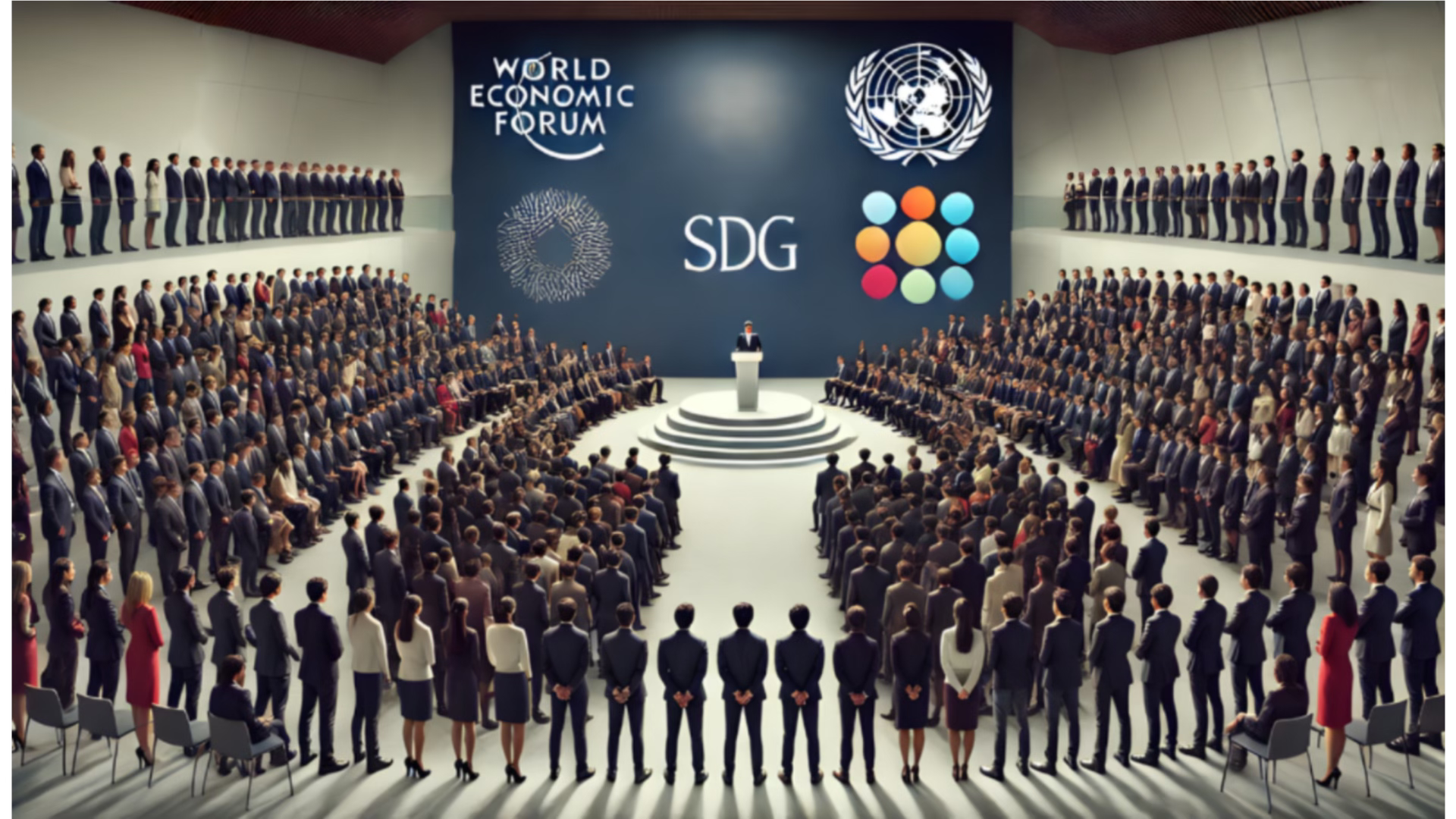
Young Global Leaders – The Elite's Ideological Breeding Ground
Øyvind Snekkestad, April 23, 2025
The World Economic Forum presents itself as a neutral meeting point for business, politics, and innovation. But behind the polished presentations and colorful graphs lies a globalist project with clear ideological guidelines. The Young Global Leaders program is not merely a leadership course. It is a long-term investment in the elite of tomorrow, shaped according to a worldview that challenges national sovereignty, democratic accountability, and traditional values. This is not a plot hatched in darkness. It is actually a project carried out in broad daylight.
A School for Globalist Thinking – Class After Class
Young Global Leaders (YGL) was established in 2004 by Klaus Schwab, the founder of the World Economic Forum (WEF). Each year, a new cohort of young, influential individuals from around the world is recruited – a new generation of politicians, business leaders, journalists, activists, and technology entrepreneurs. This is not a random assembly of young talents, but a strategic selection of tomorrow's decision-makers.
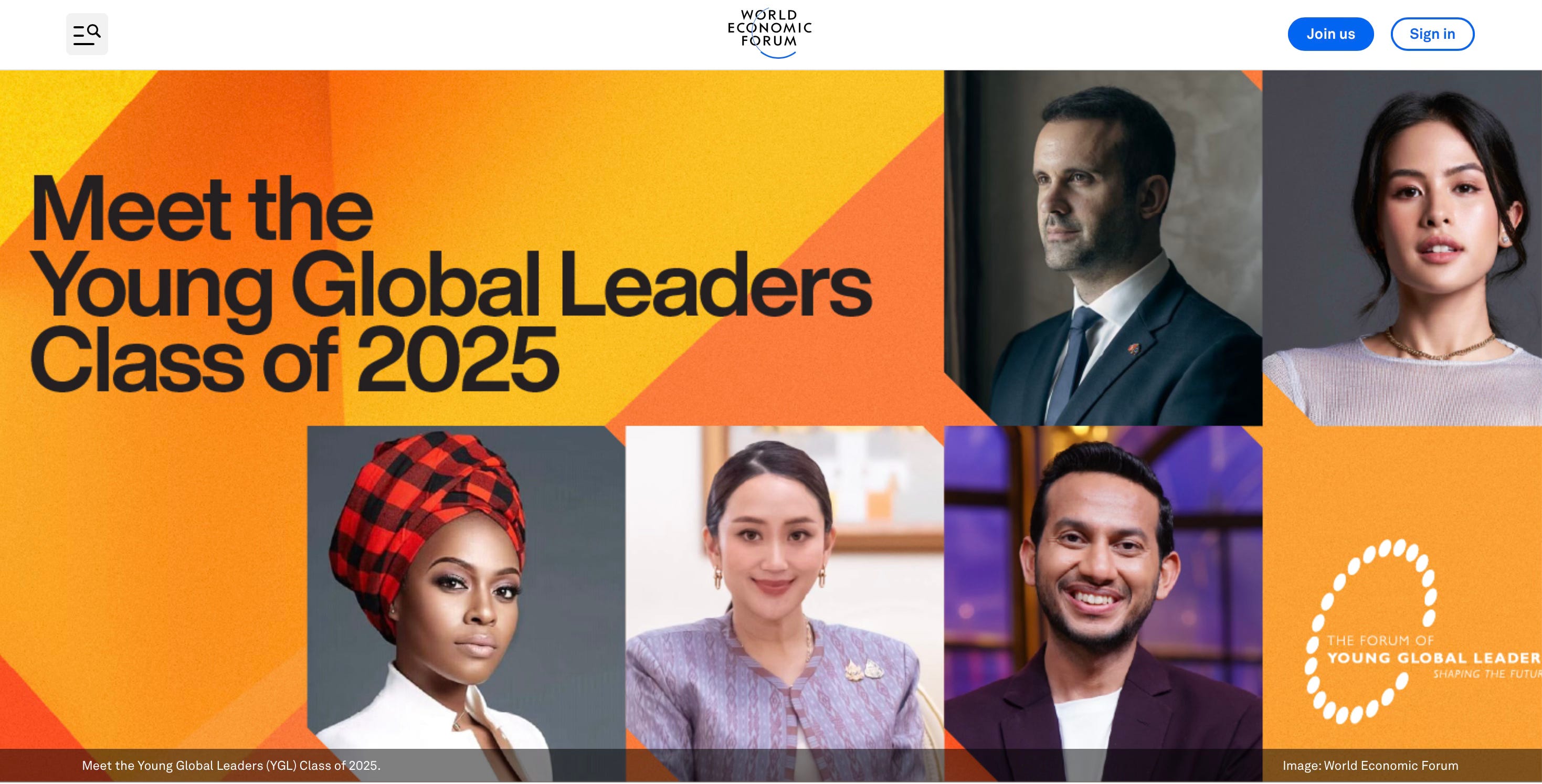
Screenshot from World Economic Forum's article about the YGL class of 2025. Source: weforum.org
The official purpose is to "shape a more inclusive and sustainable future." In practice, this means schooling young leaders in WEF's language and values – multilateralism, climate mandates, public-private partnerships, and the belief that the world's problems cannot be solved locally, but must be solved globally.
Being selected for YGL is a great honor, akin to an invitation into an exclusive club. Members gain access to global networks, specialized courses at Harvard Kennedy School, and lifelong status as alumni – a status that gives former members lifelong affiliation with the program and its environment. This belonging confers prestige and power. Many use it as a springboard to national or international leadership positions, the fruits of which we can observe in political life.
The Elite Is Shaped – With Davos as the Starting Point
YGL is not merely a leadership education program; it can also be considered an ideological incubator. Each year, a new generation of global actors is set in motion. Official lists from WEF show well-known names such as Justin Trudeau (former Prime Minister of Canada), Emmanuel Macron (President of France), Jacinda Ardern (former Prime Minister of New Zealand), Mark Zuckerberg (Meta), Sergey Brin (Google), Leonardo DiCaprio (environmental activist), and Sanna Marin (former Prime Minister of Finland). Norway also has several names in this network. Among Norwegian politicians, we find Hadia Tajik and Espen Barth Eide. The latter was not part of the Young Global Leaders program but was named a Global Leader of Tomorrow in 2003, a previous WEF program. He also held a central role in the World Economic Forum as Managing Director and member of the Forum's leadership between 2014 and 2016.
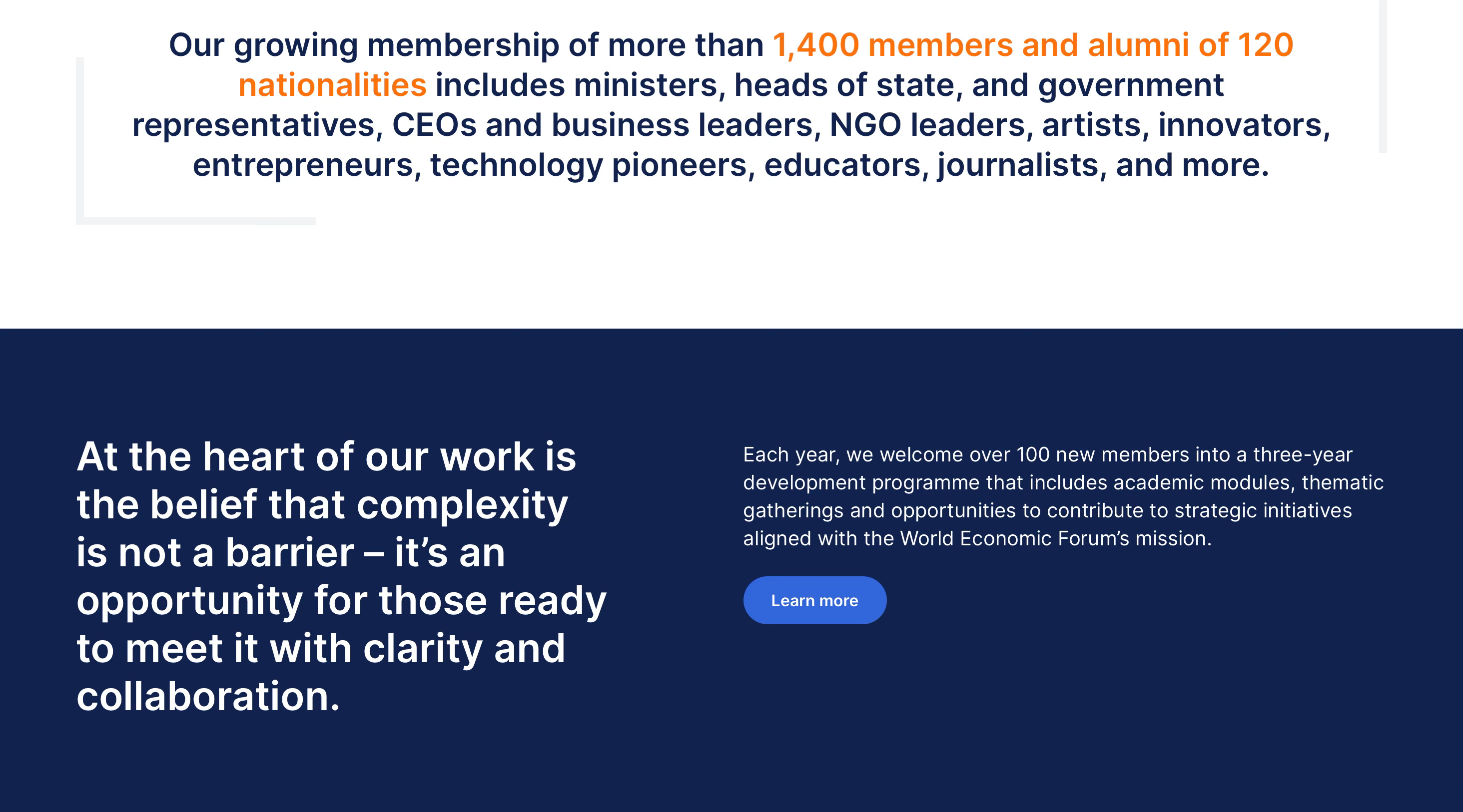
Screenshot from the front page of the Young Global Leaders website. Source: younggloballeaders.org
These individuals from every corner of the world hold great power over politics, media, technology, and economics. They operate in different sectors but share the same mindset – and this is no coincidence.
The comparison with Norway's EU debate in the 1990s is striking. Back then, key figures in the civil service and politics were sent on study trips to Brussels to "see the future." After such trips, many returned home as strong supporters of EU membership. They had seen and been shown something – apparently something that made national arguments seem less important.
This is also the method behind YGL: not through persuasion in public debate, but through exposure, networking, and ideological fellowship. The elites are shaped before the people get their say.
An Ideology with the SDGs as Its Map
At the core of YGL lie the UN's 17 Sustainable Development Goals (SDGs), which are used both as objectives and as a rhetorical framework. On the surface, the goals concern peace, equality, climate considerations, and poverty reduction. But beneath these noble words lies a governing philosophy: global problems require global solutions, and global solutions require supranational control.
The YGL program uses the SDGs as a moral compass and planning tool. Leaders are trained to think in terms of structure, regulation, coordination, and consensus – not political diversity and local adaptation.
Here, consensus does not simply mean seeking agreement, but that the framework for agreement has already been drawn up. In such an ideological understanding, consensus is often a state where dissent is marginalized and alternatives have no place in the conversation. It is not about democratic negotiation between conflicting interests, but about a shared vision that must be "implemented" – preferably without any friction whatsoever. Consensus thus becomes a linguistic shield for uniformity, where open disagreement is perceived as disruptive or immoral.
A clear example of this can be seen in Norwegian public discourse. Many leaders – not only in politics, but particularly in business – express the view that EU membership is "self-evident." Opposition is not met with arguments but with platitudes like "the different country" and the fear of "being left outside." This is not democratic dialogue, but a form of soft coercion through linguistic framing. By presenting the alternative as irrational or antisocial, a political culture is fostered where popular skepticism is not acknowledged but dismissed.
When sustainability goals and global plans are presented as morally necessary and scientifically grounded, it becomes difficult for individual countries or citizens to argue that other solutions might be better. The result is a political culture where leaders learn to govern according to a common template, rather than according to the diverse voices of the people.
A New Elite – Without Roots, Without Accountability
Through YGL, a new leadership class is created that is not necessarily loyal to the nation, but to a global community of values and visions. Many of these leaders have more in common with their fellow YGL members in Singapore, Nairobi, and Berlin than with their own countrymen.
This is not about hidden intentions, but about how people are shaped, rewarded, and positioned within a system. They go through the same processes, are given access to the same networks, and are elevated by the same system. They speak the same language, use the same concepts, and view the world through the same lens. You can find them moving between positions in politics, business, media, and academia. They have no popular mandate, but they are given structural influence. They are not chosen by the people, but by each other.
Who Elected Them?
You cannot apply to join YGL. You must be selected, invited, and then given access to be trained. It is a closed process, and those who are chosen end up in positions of enormous power. There is no popular electoral process behind this – only strategic talent scouting. These individuals later gain tremendous influence over how countries, media, and economies are governed.
This does not happen in secret, but it occurs in broad daylight with so little public attention that it might as well be hidden.
An Ideology That Must Be Exposed and Challenged
YGL is not just a program; it is also an ideological tool. It is built on ideas that experts know best: that the individual must bow to the collective, and that freedom is less important than "equality." This way of thinking dresses itself in modern language such as "inclusion," "sustainability," and "justice."
What makes it dangerous is not that it exists, but that it is not discussed. Globalism claims to be neutral, but through YGL, we see how ideological worldviews are packaged as neutral leadership programs – and later become tools for political influence.
This establishment has been allowed to develop over several decades, quietly, systematically, and without significant resistance. The project did not arise in the wake of a crisis but has rather been built gradually in the background while the world has been occupied with its ongoing challenges. And in the aftermath of the pandemic, the ongoing wars in Syria, Ukraine, and Gaza, and with the deep political upheavals in the United States, this development has gained new momentum. Now, crisis and unrest are used as proof that the world "cannot manage alone," that the solution must be more supranational governance and more coordination, that we need more "shared responsibility." What was once built quietly has now been given wings to fly.
At the same time, there are voices – including within academia and geostrategic thinking – who argue that the unipolar world model dominated by the United States and Western institutions is now losing its grip. Many see a transition toward a more multipolar worldview, where actors such as China, India, Russia, and the Global South seek greater independence and alternative power alliances.
But such multipolar reactions do not necessarily mean that globalism is under pressure and dying. On the contrary, this can be understood as a classic example of Hegelian dialectics:
First, a thesis is established – a unified vision of global governance. Then an antithesis emerges – resistance with new power centers and demands for national self-assertion. But instead of one side winning, elements from both are united in a synthesis – a new compromise, a new power structure, and a new "consensus."
Thus, the apparent upheaval and resistance become merely one step in a larger process, where global governance is not weakened but rather adjusted and strengthened with broader participation and a new language. It is not the end of globalism, but perhaps rather the next chapter.
It is precisely now, in times of crisis, that we must be most vigilant toward those who promise order without open debate. Now we see how war, economic recession, and social unrest are increasingly used as arguments to accelerate globalist projects. In Norway, the once-dormant pro-EU membership side has once again caught a wind in its sails.
It is important that Norway not allow itself to be led by those who have been schooled, shaped, or seduced by the language and structure of globalism. In a time when power is being centralized and loyalty is shifting from people to networks, we must remind ourselves of who we are and what responsibility we have to protect freedom, sovereignty, and what is ours.
References
- World Economic Forum. (n.d.). Young Global Leaders. Retrieved from https://www.weforum.org/communities/young-global-leaders/
- World Economic Forum. (n.d.). YGL Alumni. Retrieved from https://www.weforum.org/communities/ygl-alumni/
- United Nations. (n.d.). The 17 Goals – Sustainable Development. Retrieved from https://sdgs.un.org/goals
- Harvard Kennedy School. (2022, March 16). Four HKS alumni have been named Young Global Leaders. Retrieved from https://www.hks.harvard.edu/alumni/connect/community-stories/four-hks-alumni-have-been-named-young-global-leaders