Globalism: An Ideology That Claims It Isn't One
Øyvind Snekkestad, April 14, 2025
In our time, globalism presents itself as a moral necessity, not as an ideology. It promises peace, climate responsibility, social justice, and diversity. But behind this neutral facade lies a worldview that attacks sovereignty, individualism, and traditional values. Globalism is not merely politics—it is an ideological force that clothes itself in universal virtues to conceal its true agenda.
An important starting point for this worldview can be found in the book Our Global Neighborhood (1995), a report published by the Commission on Global Governance, where the vision of a global governance system with strong institutions and shared values was laid out in 1995. Our Global Neighborhood functions in practice as a manifesto for a new world order. It presents itself as a roadmap, but in reality, it is full of political directives: the UN should be strengthened, national sovereignty must yield to global solutions, and international institutions should gain more power. The book expresses a worldview where governance from above and shared global values should dominate over local anchoring and national interests.
Although the book was not launched as official UN policy, many of its proposals have found their way into the political language of the UN, EU, and NGO circles. It constitutes an ideological foundation for a global movement that still claims it is not ideological.
A New World Order Without Debate
Globalism presents itself as the answer to the world's problems: war, inequality, climate change, racism, hate crimes, and poverty. It sounds reassuring. Who could be against peace, climate responsibility, and justice?
But herein lies the power, because whoever owns the language owns the politics. When a political project is disguised as morality, resistance becomes not only unwanted but also immoral.
Globalism has therefore succeeded at something ideologies rarely achieve: it has become a non-ideology and a "necessity." Nothing less than a default setting for the entire West. Globalism has succeeded in defining itself as an ideology-free platform for progress. But in reality, it is deeply ideological, and at its core, antidemocratic in form.
Supranational bodies, UN conferences, NGO networks, and multinational corporations pull the strings, while ordinary people are reduced to consumers and recipients of policy, not citizens with influence.
An Ideology with a Left-Wing Core
Behind the inclusive language of cooperation and shared responsibility lies a systematic mindset. Behind the slogans, we find a worldview that is anything but neutral:
- The belief that all problems must be solved collectively, across borders.
- A systematic distrust of the nation-state and its democratic self-governance.
- A worship of structure over the individual.
- An assumption that inequality in itself is unjust.
These ideas are not new. They are recognizable from Marxism's critique of class, power, and property, now resurrected in global garb. It is the belief in system over individual, in community over differences, and in equality over freedom. This is the core of the global narrative.
The UN, World Bank, EU, and World Economic Forum promote this worldview with impressive unanimity. And political parties in nation-states, from both the right and left, have long ago adopted globalism's language.
Globalism does not place its trust in open debate and local anchoring, but in universal declarations and expert councils. It is not the people who should solve the problems, but the experts, who are then considered the right people with the right values.
The Sovereignty That Must Yield
Conservatism is built on a belief in the familiar, the known, and the responsible. In this worldview, the state is an extension of the family and local community, not an experimental laboratory for utopian ideas. Globalism attacks this thought and these values directly.
The conservative principle of national self-determination is under massive pressure. Laws and regulations are shaped in supranational bodies, where democratic accountability disappears in processes in which you and I have no voting rights. National parliaments become administrators rather than legislators. Prime ministers become governors instead.
Through treaties, declarations, and conventions, national sovereignty is undermined bit by bit. The UN, EU, WTO, WHO, and WEF influence laws and practices in hundreds of countries without direct democratic anchoring. It happens in the name of climate, in the name of justice, and especially in the name of diversity.
And while ordinary people still feel loyalty to homeland, culture, and language, the globalists tell us that "we are world citizens." You should no longer be Norwegian, German, or French. You should be a unit in a global movement for equality and responsibility.
Sovereignty is portrayed as old-fashioned, exclusionary, and dangerous. In reality, it is sovereignty that protects the citizen from the boundless apparatus of power, but remember that it is the nation-state that holds politics accountable. It is the one that sets boundaries, both literally and politically.
The Dangerous Price of Equality
Globalism promotes an ideal of equality but rarely speaks about what it entails in practice. If all people are to have "equal opportunities," differences in abilities, choices, and culture must also be leveled. And to level, one must control, and certainly punish some. One will reward some, unfortunately control, and confiscate from others.
The ideal of equality is the very sanctuary in globalism's temple. But equality in what sense? Equality in opportunities or outcomes? Experience shows that the more one insists on equality of outcome, the more power is required to achieve it.
It is not unlike the Marxist project of the former Soviet Union. Except that this time it comes packaged in terms like "sustainability," "justice," and "human rights." It sounds noble, but if you follow the logic to its end, you face the same situation as in the former Soviet Union: an authoritarian order, governed by bureaucrats with seemingly good intentions.
The Soviet Union showed us how far the ideal of equality could go. Owning a larger house than one's neighbor was unjust, regardless of how it was earned. And thus equal worth was confused with equality; those who stood out with a larger house were punished and deprived of what they owned. It was not permitted to have a larger house than one's neighbor. Equality as an ideal is not neutral, but political. And when it is promoted by forces outside democratic control, it becomes dangerous.
The Green Red Color
The environmental movement is one of the most successful tools for promoting globalism's message. It appears objective and scientific but carries with it a core of control ideology.
The environmental movement appears as a new green ideology, but many of the solutions it advocates are deeply red, ideologically speaking:
- Central control of energy policy
- International climate agreements that override local needs
- Economic punitive measures against those who do not "follow the line"
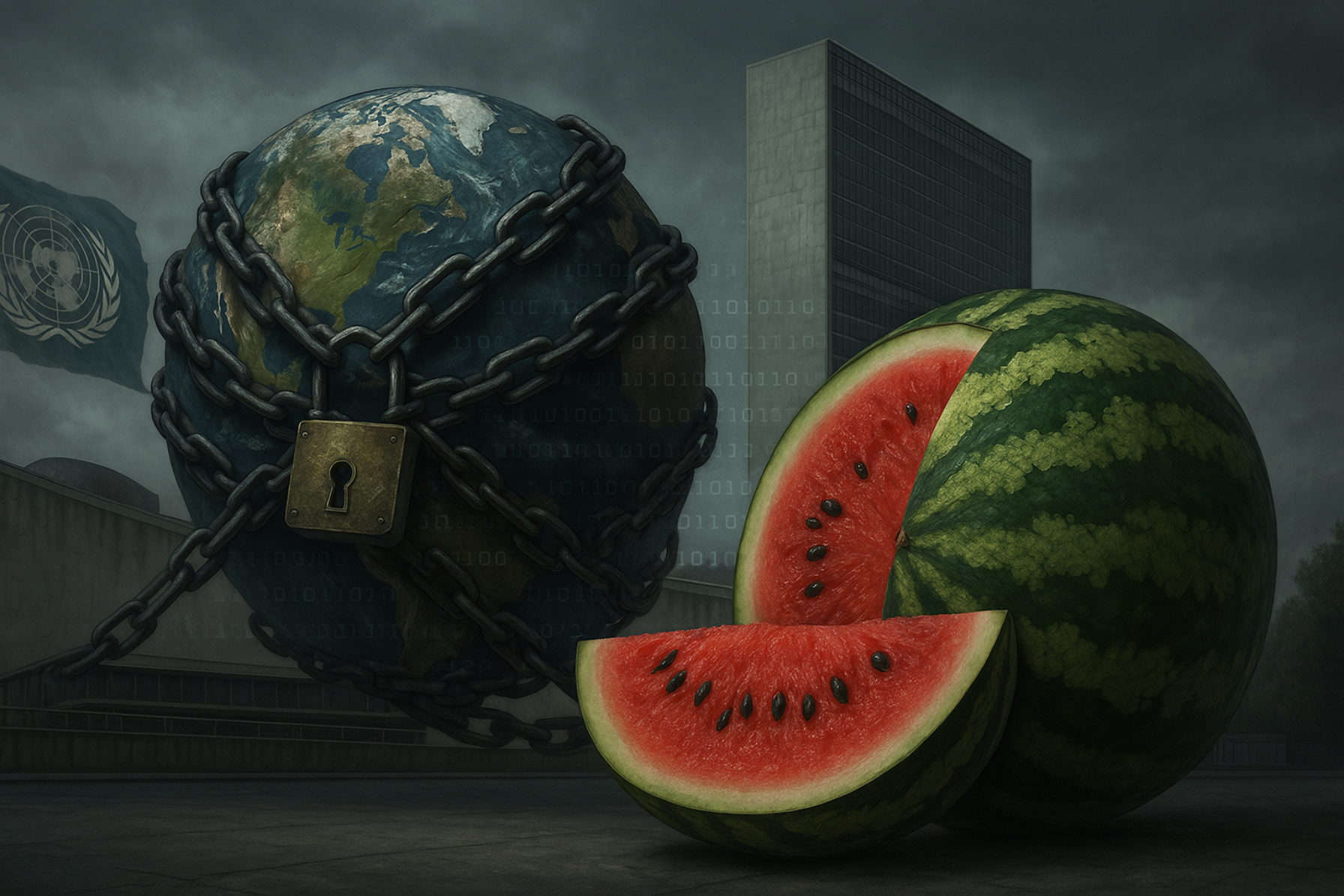
Picture a watermelon. It has a beautiful green color on the outside, but it's bright red on the inside.
Behind the climate engagement lies demands for global redistribution and a reduction in consumption. It wants regulation of production, changes in value chains, and limitation of individual freedom. It is a systemic change masked as a moral responsibility. People who question these measures are branded as "climate deniers." The environment is an excellent excuse for global governance, and it works. Who could be against saving the planet?
We Must Dare to Oppose
It is not a question of whether one wants justice, peace, or sustainability. It is a question of how and who should decide. Globalism offers a world where elite organizations set the framework for our lives instead of our national communities.
We must not be fooled into thinking that globalism calls itself value-neutral. It is anything but that. Yes, it has values, it has a worldview, and it has a political strategy. This does not mean that all international cooperation is wrong, but we must be able to ask questions about who governs and who has power. Who loses when we surrender sovereignty, and who defines justice?
Conservatism stands alone in many of these debates, but precisely for this reason, it is important. It reminds us that freedom requires boundaries, that diversity requires frameworks, and that community is built from the bottom up, not from the top down. But when an ideology refuses to admit that it is an ideology, then we must be especially vigilant.
References
- Commission on Global Governance. (1995). Our global neighborhood: The report of the Commission on Global Governance. Oxford University Press.