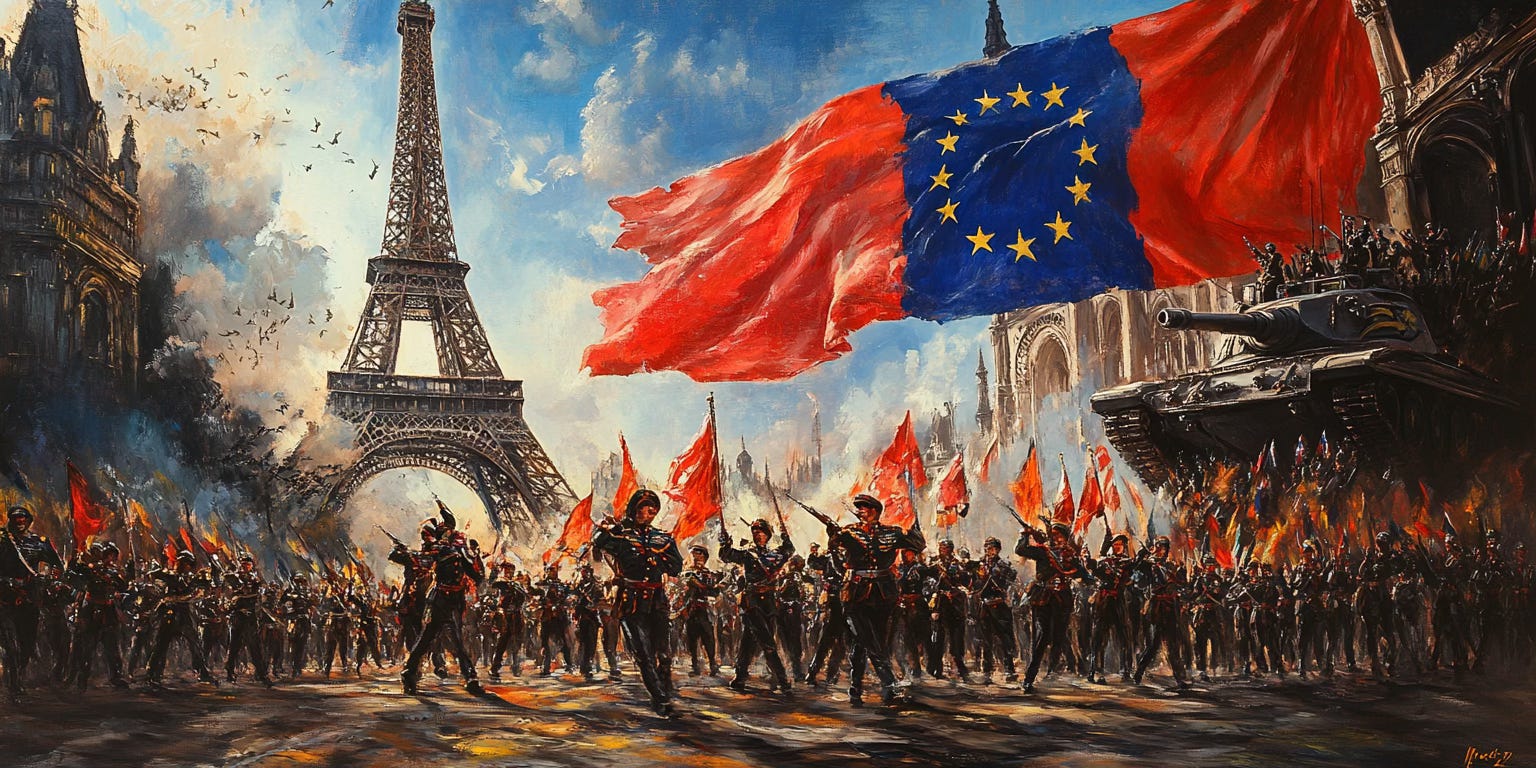
Are You Ready for the United States of Europe?
Øyvind Snekkestad, February 26, 2025
I was truly astonished when I opened VG's website on Tuesday, February 25. On the front page, I read the headline: "The EU must become one state." For someone who has followed developments in Europe and our own political discussions, it was impossible to overlook the gravity of this claim.
Should we now say that the media campaign for Norway to become an EU member has begun? It is difficult to escape the feeling that we are witnessing a methodical delivery of a message. The media holds great power, but few journalists and editors will acknowledge that their reporting is influenced by an underlying agenda. For news to appear objective, it is important that the sources used are diverse and without an obvious interest in promoting a particular viewpoint.
Unfortunately, there are many examples of media deliberately creating biases in how a story is presented. When articles place strong, polarizing opinions at the center of the material and then add an opinion poll that harmonizes with the message, this can manipulate how people think about the issue. Not necessarily through outright falsehoods, but through controlled communication that influences the reader's emotional response. This is a strategy well known in the world of journalism, particularly in campaign journalism.
In the article on VG's website, there is a clear emphasis on military expert Guillaume Ancel's claim that the EU needs to become one unified state with one common army, and that Europe must become a superpower to stand against threats from the USA, Russia, and China. There is no doubt that such a statement is designed to provoke reactions. In an opinion poll that follows directly below the article, the results are overwhelming: 62% of respondents believe that Norway should be part of a unified EU state. This figure may be the result of readers' emotional reaction to the article's dramatic content, which promotes fear that Norway will be left defenseless unless we become part of this grand European superpower.
When we look back at Norway's referendum in 1994 on whether we should join the European cooperation, many of us remember how the debate was presented as a discussion about economic cooperation rather than a political union. It was never addressed as a strategy for disinformation, but in hindsight, it is easy to see that many of the arguments used were misleading. For example, there was a widespread claim that membership did not necessarily entail a greater political community, but rather an economic cooperation. This view was never fully confronted in the media, and the role that disinformation can play in the communication of political issues was never thoroughly debated.
When we read the VG article we referenced, it is clear that this is no longer merely about economic cooperation. Military experts like Ancel are open about the fact that it concerns forming a European superstate, and when the media places such claims on the front page, we can expect to hear more about this in the time ahead.
At the same time, it is important to point out that there is political opposition to this development. Several national leaders have been clear that a common EU army and a European superstate are not on the agenda. This stands in contrast to the picture painted by Ancel and news agencies such as Agence France-Presse (AFP), a partly state-funded French news agency that often conveys perspectives aligned with French political interests. Nor is this the first time we have seen a systematic attempt to create public opinion around such a major change.
Furthermore, it is worth noting how politicians who, in this case, have rejected the claim of a superstate, emerge from the debate as the more neutral and sensible actors. Nevertheless, the opinion poll in VG shows that 62% of respondents believe Norway should join the EU as one unified state—a clear indication of how the media can create a narrative that manipulates public opinion. If we were to follow the politicians' actual position, this opinion poll should have looked entirely different. This is not an honest reflection of a free, informed population. It is the result of a campaign that deliberately steers the debate and people's perceptions.
The question therefore becomes: Are we ready for the "United States of Europe"?
The answer is far from obvious. When politicians actually reject this as a reality, but the media nevertheless drives the idea forward and makes people believe it is an inevitable fate, we should be on our guard. This is not about a balanced and informed debate. It is a narrative construction with clear political objectives. Perhaps it is not only the "United States of Europe" we should be skeptical of, but also who is actually shaping public discourse and why. We live in a time of information overload, and it is important that each of us remains vigilant about what we hear and see. By using our discernment better, we can assess what is genuine and balanced, and what may be manipulation.
References
- Ulvin, P. B. (2025). European superstate: "We have no choice." Retrieved from https://www.vg.no/nyheter/i/wgJj2n/europeisk-superstat-vi-har-ikke-noe-valg